.png)
Look at Brookville
The articles below provide a glimpse of yesteryear in Brookville, Ohio. These articles and pictures are compiled from information contained in our vast collection on area businesses, people, events, calamities and other items too numerous to mention. We hope you will enjoy reading these samples.
__________________________________________________________________________________________________________________________________________________
Samuel Spitler was born on Dec. 3, 1861, near Brookville and was the only child of Daniel and Prudence Litten Spitler. He lost his parents at the age of nine leaving him with two maiden aunts and a bachelor uncle, David Litten.
Under the supervision of his uncle he started his work career in the Litten flour mill. Later he operated a drug store, then he pursued his interest in things mechanical and in later years studied heating and hydraulic installations. He was the supervisor of the installation of the Brookville Water Pumping Plant.
He had a keen interest in all scientific innovations and was an accomplished photographer. He had a complete understanding of photographing technique and his work approached professional quality.
He married Ettie Weaver Spitler in 1889 and they had one daughter, Anona Spitler Stoner. In 1894, Samuel Spitler built what is now known as the Spitler House Community Museum. The house was erected for Mr. Spitler by Warren Rasor, a local craftsman. It was originally located at 15 Hay Avenue and was saved from demolition when the Brookville Historical Society formed in 1973. It was moved to its present location at 14 Market Street in 1974. It is one of Southwestern Ohio’s finest examples of Queen Anne Architecture. Samuel Spitler is credited with installing Brookville’s first indoor bathroom in this house. The house also had the first acetylene lighting system in Brookville. A generator was installed in the basement which charged and re-charged with carbide to produce the gas for overall lighting.
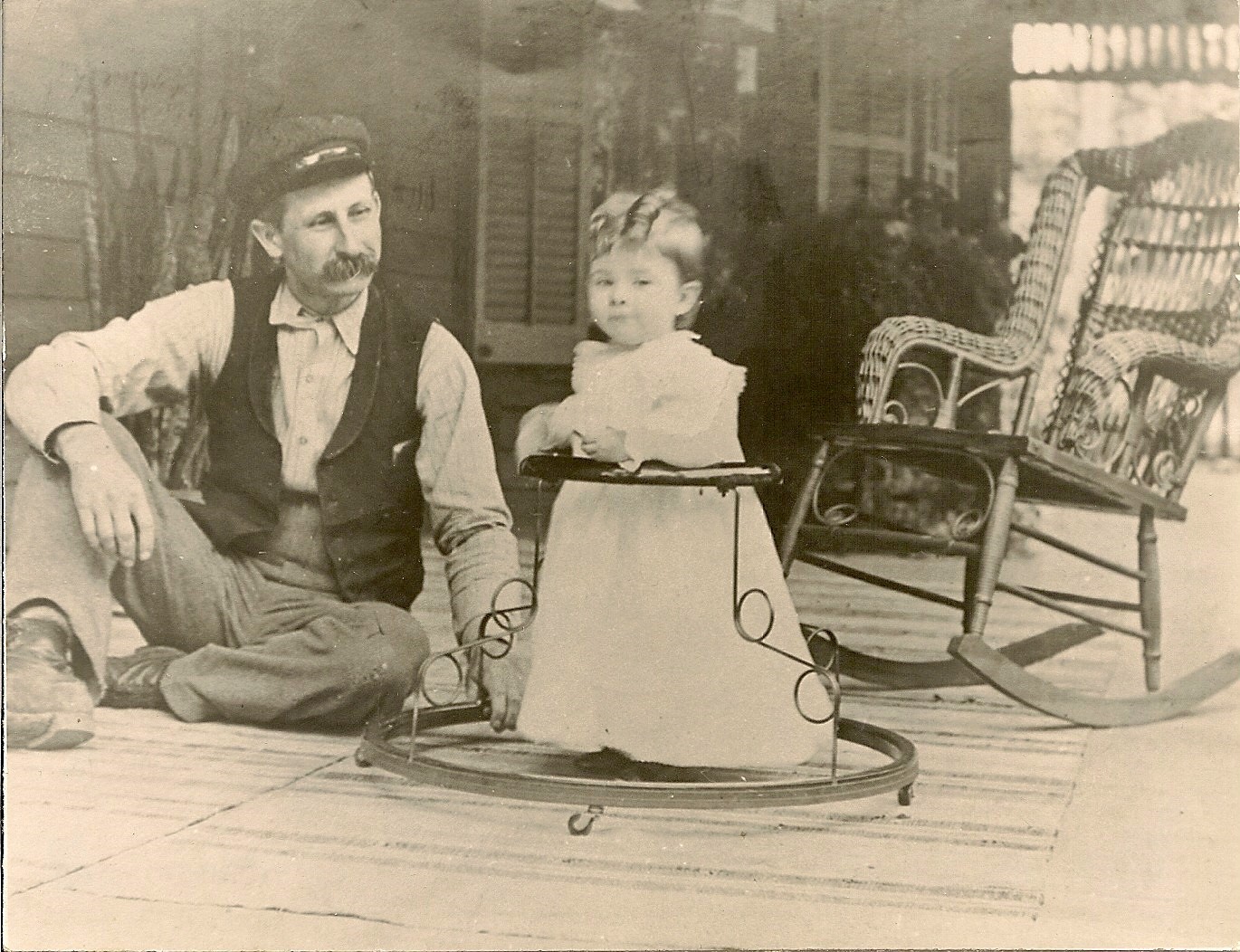
Mr. Spitlers wife, Ettie Spitler was a charter member of ’The Clio Club’ and many meetings were held at the Spitler Home. Also, the Brookville Library began in the early 1900s in this house. The house also was the original center and leadership for the Red Cross activities and war relief sewing during 1917-1918- later transferred to the Masonic Lodge room when more space was needed. Shown in the picture are Samuel Spitler and his daughter Anona, which was taken around 1905 (note the early style walker). Anona was a 1922 graduate of Brookville High School and later graduated from Antioch College. She worked diligently with the Brookville Historical Society when the restoration of the Spitler House was being completed. It was restored as close to its original state as possible with her assistance, including wallpaper, floor coverings, paint and much more.
_______________________________________________________________________________________________________________________________________________
In 1934, the Brookville High School Band, under the direction of Mr. Zaner Zerkle, played for the opening ceremonies of the Brookville National Bank, located on Market Street. Fifty years later in 1984, the band was asked to play for the bank’s 50th anniversary celebration.
In 1934, the band was just an orchestra. Mr. Zerkle came to the high school in 1932 as a music teacher. He formed the marching band consisting of 35 people in 1934. A few of the members were Dale Meyers, Walter Zumbrun, Eddie Kendall, Wentworth Burkett, Cecile Fasnacht, Earl Diehl and Lillian Osswald.
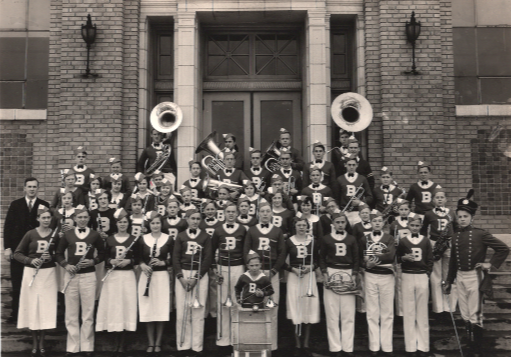
This newly formed band couldn’t afford uniforms, so they wore white slacks or skirts, sweaters, and bowties. Another problem arose before one of their concerts, a trumpet player was missing so Mr. Zerkle’s brother, Ward Zerkle, a trumpet player himself played the part and save the day. Mr. Zerkle wrote the words to the Brookville fight song. In 1934 he was chosen to lead the all-County Band at the County basketball tournament. The band played at home basketball games. They would form the letter “B” on the floor of the pit gym of the 1923 high school and play the fight song for the fans.
The “away” band performances were more like the pep band of today. The pep band was informally organized and consisted of about 5 or 6 kids. Earl Diehl organized the first Brookville pep band when he was still a student.